No, we didn’t misspell “lead.” The United States Green Building Council oversees the Leadership in Energy and Environmental Design (LEED) program, a 20-year-old effort to promote environmentally responsible construction practices and sustainable buildings. To receive a LEED certification, site managers and designers can accumulate points in categories such as water efficiency, materials and resources, and innovation. Everything from location to landscaping factors into a project’s overall score.
LEED’s point-based system has four levels of certification: certified, silver, gold, and platinum. Since 2011, the UW has earned 15 LEED certifications for new campus buildings and renovation projects, racking up one platinum-level and eight gold-level awards. UW–Madison is also recognized on the Environmental Protection Agency’s Green Power Partnership Top 30 College & University Partners list for its commitment to environmental stewardship.
While earning a platinum and plenty of golds and silvers certainly feels great, administrators at the UW are more excited about what the designs behind the accolades will do for Badgers. LEED-certified buildings give students and employees healthier places to study, work, and live. Community members also benefit from cleaner air and water systems. As campus buildings continue to be upgraded or replaced according to LEED standards, the UW is working to sustain its people with modern resources, as well as the surrounding environment.
Take a virtual walk through campus to learn more about the UW’s LEED-certified buildings.
UW Medical Foundation Centennial Building
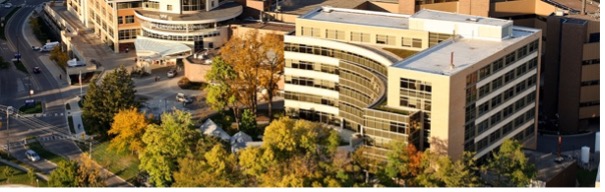
The UW Medical Foundation Centennial Building was the first building on campus to earn a LEED certification. The building is named to honor the 100th anniversary of the UW School of Medicine and Public Health and houses administrative offices for UW Health faculty physicians and staff.
LEED rating: gold level
Year certified: 2011
Sustainability features:
- Energy use for lighting was reduced by 80 percent through the use of daylight sensors and strategic lighting design.
- Landscaping includes a rain garden — a depressed area planted with grasses and plants to manage stormwater runoff.
- Including a green, vegetated rooftop, and reflective roofing and pavement materials, 50 percent of the site is designed to decrease heat absorption.
Education Building
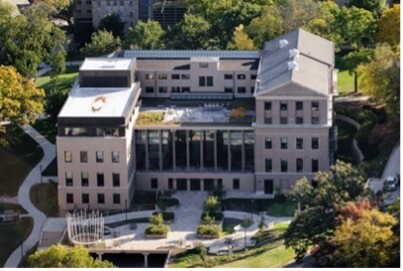
The Education Building, built in 1900, went through extensive renovations in 2010. The work was enough to earn a platinum-level LEED certification, making the Education Building the second LEED-certified building on campus and the UW’s highest-rated building.
LEED rating: platinum level
Year certified: 2011
Sustainability features:
- Two green roofs to reduce impacts of stormwater runoff
- Water-conserving fixtures to reduce water use by 40 percent
- Thoughtful design to reduce energy use, including maximizing daylight and installing lighting with occupancy sensors
Wisconsin Institutes for Discovery
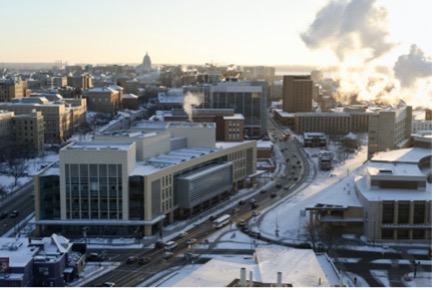
The Wisconsin Institutes for Discovery Building, completed in 2010, houses the privately owned Morgridge Institute for Research, the UW’s Wisconsin Institute for Discovery, and a public Town Center for collaboration between researchers, industry experts, and community members.
LEED rating: gold level
Year certified: 2011
Sustainability features:
- Throughout construction, 88 percent of waste material was recycled.
- The building maximizes use of daylight and LED lighting fixtures to reduce energy use.
- A geothermal HVAC system uses the earth’s geothermal energy to redistribute heat throughout the building.
Union South
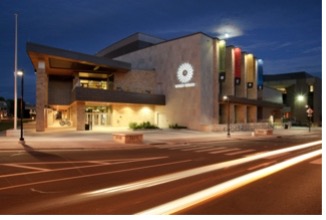
The new Union South opened in 2011, providing students with a 21st-century building to host meetings, grab lunch, and attend large gatherings. The building completely replaced the old Union South, and even the demolition took place with sustainability in mind: 90 percent of the materials from the old building were recycled.
LEED rating: gold level
Year certified: 2012
Sustainability features:
- A 7,853-square-foot vegetated green roof surface to capture stormwater and minimize heat absorption
- Energy-efficient design strategies, such as occupancy sensors and an abundance of daylight
- Compost receptables that collect approximately one ton of waste every week
Barbara Hochberg Center for Jewish Life
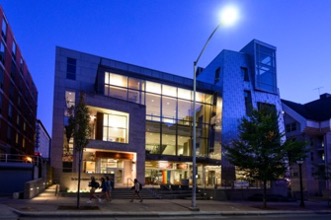
The Barbara Hochberg Center opened in 2009 and houses UW–Hillel, a group committed to supporting the UW’s Jewish students, faculty, and community members. The center holds a library, a café, and dining rooms for group shabbat dinners, as well as an auditorium for special events.
LEED rating: gold level
Year certified: 2012
Sustainability features:
- Landscaping design resulted in a 50 percent reduction of water use, and no potable water or irrigation methods are used.
- Underground parking reduces heat absorption and maximizes green spaces.
- Low-emitting carpet, composite wood, and paint are used throughout the building’s interior.
Nancy Nicholas Hall
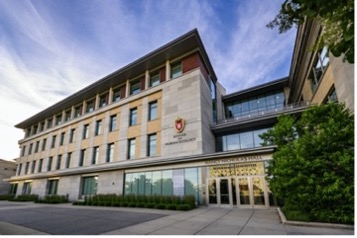
Nancy Nicholas Hall, built in 2012, houses the School of Human Ecology. The thoughtful design of this building earned campus its fifth LEED certification and provided the School of Human Ecology and its programs a centralized home with increased space for research and collaboration.
LEED rating: gold level
Year certified: 2013
Sustainability features:
- Underground parking maximizes green spaces and decreases heat absorption.
- During construction, 95 percent of waste and materials were reused or recycled.
- Landscaping features native, drought-tolerant plants to conserve water.
Student-Athlete Performance Center: McClain Center
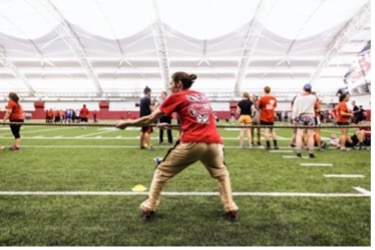
Built in 1988, renovations to the McClain Center in 2013 vastly improved the facility for student-athletes and earned the building a silver-level LEED certification. In this remodel project, the Department of Athletics rebuilt the lower level to hold more locker rooms and lounges as well as modernized the Mueller Sports Medicine Center.
LEED rating: silver level
Year certified: 2013
Sustainability features:
- Each year the McClain Center’s lower level uses 575,000 kWh of wind power as an energy source for operations.
- Local sources provided 20 percent of the materials used in the renovation.
- Construction waste was responsibly managed.
LaBahn Arena
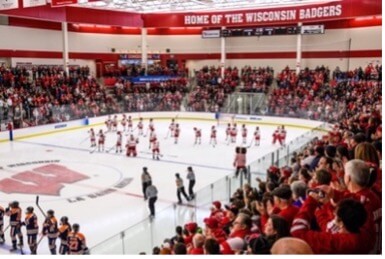
The LaBahn Arena addition to the Kohl Center in 2012 provided the UW women’s hockey team with its own facility and offices. LaBahn is also home to the UW swimming and diving teams, with additional locker rooms, a team lounge, and room for physical therapy on the second floor.
LEED rating: silver level
Year certified: 2014
Sustainability features:
- First use of BubbleDeck technology in the United States, a construction technique that combines concrete, steel, and plastic bubbles to reduce the amount of concrete needed
- Built as an addition, which reduces overall footprint and environmental impact
- Easily accessible by public transportation
Aldo Leopold Residence Hall
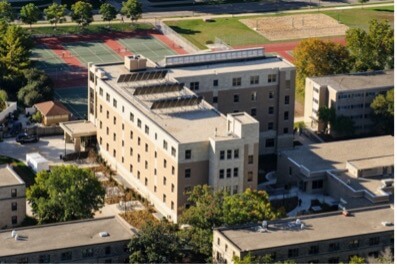
Aldo Leopold Residence Hall was built according to its namesake’s environmental standards. Planners from University Housing designed this dorm to be the most sustainable student housing on campus. After its completion in 2013, Leopold Hall earned a gold-level LEED certification.
LEED rating: gold level
Year certified: 2014
Sustainability features:
- A rooftop greenhouse, along with the GreenHouse Learning Community, students dedicated to sustainability and energy efficiency
- Roof-mounted solar panels and use of wind-generated power
- Locally sourced construction materials
Signe Skott Cooper Hall
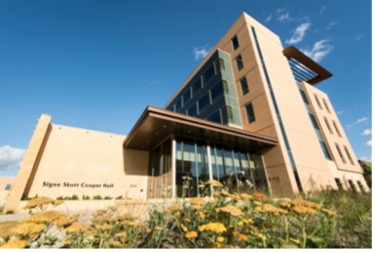
The School of Nursing was given a new home with the completion of Signe Skott Cooper Hall in 2014. Cooper Hall allows nursing students and faculty a dedicated space for research and collaboration, as well as gives students an opportunity to train in high-tech simulated clinical environments.
LEED rating: silver level
Year certified: 2014
Sustainability features:
- Renewable sources, including wind, solar, and landfill gas, provide 35 percent of Cooper Hall’s energy supply.
- A vegetative green rooftop reduces heat absorption and decreases stormwater runoff.
- It’s central location, with 13 bus stops within a quarter mile, encourages use of public transportation.
Wisconsin Energy Institute
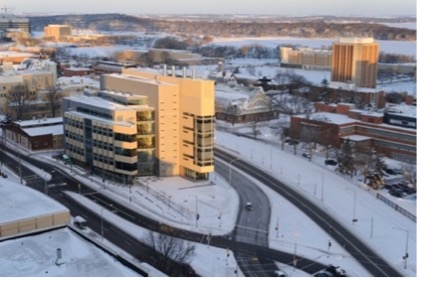
Opened in 2012, the Wisconsin Energy Institute (WEI) is an interdisciplinary research building dedicated to clean energy solutions. With its gold-level LEED certified building, WEI proved that state-of-the-art construction can be clean and energy efficient.
LEED rating: gold level
Year certified: 2014
Sustainability features:
- Solar panels on two levels of rooftop produce 26 kilowatts of electricity that go directly into WEI’s electrical grid.
- Reclaimed and recycled materials are used throughout the building, including wood, glass, steel, and carpet.
- Low-flow plumbing fixtures help decrease water use by 33 percent.
Student-Athlete Performance Center: Camp Randall North Addition
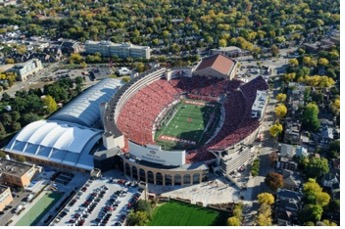
Camp Randall’s Stephen M. Bennett Student-Athlete Performance Center and its three-story addition on the north end of the stadium were part of a multiphase project to improve amenities for student-athletes across all 23 athletic programs. Completed in 2014 and designated a silver-level LEED building, the north addition houses strength-training facilities and an academic center.
LEED rating: silver level
Year certified: 2015
Sustainability features:
- Use of low-emitting materials and chemicals in paint, flooring materials, and sealants
- Additions to current buildings reduce overall footprint and minimize heat absorption
- Easily accessible by public transportation, biking, and walking
Wisconsin Institutes for Medical Research
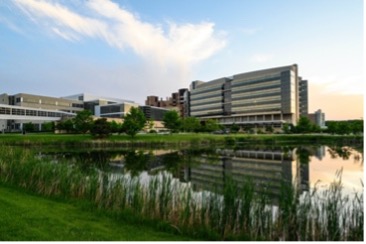
There were multiple phases of construction for the Wisconsin Institutes for Medical Research (WIMR). The first phase was completed in 2009. In 2013, the second-phase WIMR complex, a nine-story tower, was completed, earning a gold-level LEED certification.
LEED rating: gold level
Year certified: 2016
Sustainability features:
- Recycled 75 percent of construction waste — 6,593 tons of materials
- Donated 4.7 tons of copper, totaling nearly $20,000, to the American Family Children’s Hospital to use in a concurrent project
- Easily accessible by public transportation and provides bicycle storage and changing rooms
Memorial Union and Terrace Renovation
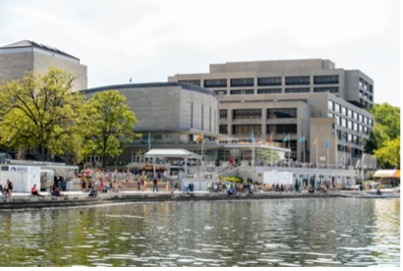
In 2017, the Wisconsin Union completed its multiphase renovation of Memorial Union and the Terrace. Historical spaces such as der Rathskeller, Gekas Commons, and the Terrace were restored, and other areas for dining and studying were upgraded to accommodate more students and visitors.
LEED rating: silver level
Year certified: 2018
Sustainability features:
- During construction, 95 percent of construction waste was recycled or salvaged, including glass blocks, limestone, and theater handrails.
- Updated HVAC systems increased energy efficiency by 40 percent.
- Part of the Terrace renovation project included rebuilding 800 feet of shoreline, resulting in cleaner water and a healthier habitat for wildlife.
Hamel Music Center
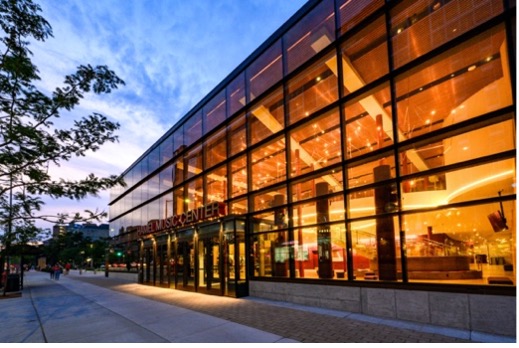
One of the UW’s newest buildings, the Hamel Music Center was completed in 2019 to house new performance and rehearsal spaces for the Mead Witter School of Music. The building required special design strategies to ensure high-quality acoustics and soundproofing.
LEED rating: certified
Year certified: 2021
Sustainability features:
- Built in a busy, populated area, helping to limit urban sprawl and environmental impact
- Precast concrete panels manufactured in nearby Germantown, Wisconsin