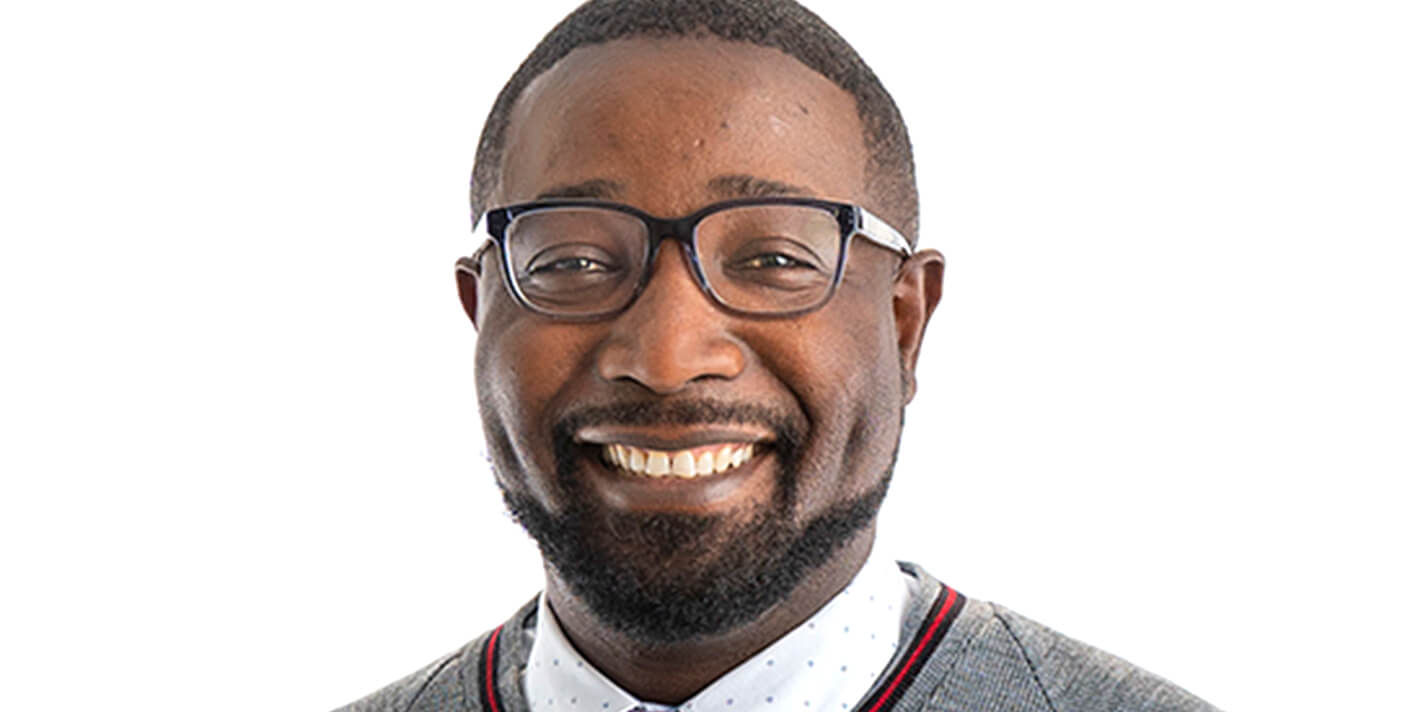
“Beaches all around, beautiful skies, beautiful food, just beautiful people.” That’s how Alvin Thomas describes his home island of Saint Lucia, located in the Caribbean. But it was the people, and the not-so-idyllic social and economic issues they faced, that inspired Thomas to pursue psychology. He wanted to find ways to support people “who were being raised in spaces that required significant amounts of resilience and internal strengths.” Thomas is now a professor of human development and family studies at the UW School of Human Ecology and the director of the Thomas Resilient Youth Lab (TRYlab). His research centers on positive youth development and family dynamics, with a particular focus on the mental health of Black men and boys. Read more about his work and how he’s seeking to build up Black and low-income communities around the world, not just on tropical islands.
What are some of the barriers that Black families and young Black men in particular face?
When I consider the kind of work that has to happen, I think what we often don’t pay attention to is the historical trauma that has been passed down to families. The historical trauma is not just individual. It’s also familial; it’s also community-based. There’s been historical trauma revisited continuously on Black families and on low-income families. Not just Black families, but specific to my work, Black fathers. So, the historical trauma revisited all the way back from the first round of human trafficking of Black bodies from Africa to the west, into America, into the Caribbean, and other parts of the west. And we still are living out some of the trauma that is associated with this large-scale crime of human trafficking and victimization of Black bodies. We’re seeing it in some of our systems. We see it in our child welfare system. We see it in our legal system where the focus on keeping families connected is not present.
Why does the father-child relationship have such bearing on societal outcomes?
As part of the human trafficking, fathers were sold out of families. Fathers were stripped from families; families were stripped of the contribution of fathers, and we see the effects continuing today. The messages and the stories and the impact of that immediately for those children who were victims of that human trafficking, for the women and mothers who were victims of that human trafficking, that impact was passed on to their children. Their children grew up without their fathers because of that human trafficking, because of that cruel system that existed. And those children passed on some of those same values. Some of those same ways of being — some of those same understandings of their world, understandings of their lives, understandings of their community — were passed on to their children and their children passed it on to their children until it came down to us.
A lot of my work has always been focused on trying to understand how we can create support systems that prop up nonresidential families so that we start to see the family, not just as mother and child, but as a system that includes the father, even if the father may not physically be present. But when the father is present, sometimes we don’t even include him then. So, [my work focuses on] understanding that the family is a system, and it includes all the individuals, mother, father, and child, and whoever else that system decides to include in their space.
What are things we can do that help promote healthy development on the individual, family, and community levels?
One of the things that I talk about is the idea of collective efficacy. And that’s the idea that every family or every household in the neighborhood has a shared set of values within the community. There’s a value for providing help. There’s a value for physical health. There’s a value for safety. There’s a value against violence. There’s a value against domestic violence. There’s a value against crime. There’s a value against drugs. There’s a value against alcoholism.
But [collective efficacy is] the assumption that Ms. Mabel, who lives two doors down from me, has the same values around protecting children that I have. So, when I am not present and my child is at the end of the block playing basketball or football or hockey with some other kids, Ms. Mabel is sitting on her stoop, crocheting, or peeling peas, or watching her YouTube videos or whatever she’s doing. But, because I know she shares the same values as me, I know that if my kid and the other kids have some kind of conflict, I know that she’s watching and that she’ll intervene, right? Because we share the same values, it creates a space in the community that’s wholesome, and it creates safety for the children, but also for the adults in that space.
Can you share some of your research projects that have been most meaningful or striking to you?
One that I’m working on with a colleague, Tova Walsh from the Sandra Rosenbaum School of Social Work, is a collaboration with an organization in Milwaukee called the African American Breastfeeding Network. We’re focused on understanding and improving maternal and infant health, but we want to also understand where fathers fit in that nexus.
The other bigger study that I’m working on is with the Urban League of Greater Madison and Rebalanced-Life Wellness Association. This is part of a $1 million grant given to us by the Wisconsin Partnership Program. The grant covers five years of work. Five years to focus specifically on the mental health of Black men and boys. And my specific piece is working with the Urban League around fatherhood. There’s currently a fatherhood initiative at the Urban League. The expectation is that we’re going to add a mental health component to that and put fathers — we’re hoping for cohorts of five to 10 fathers — through an eight-week fatherhood program. [Our research will determine] whether or not we see significant increases in their perceptions of themselves, their mental health, their role as fathers, the importance of their role as fathers, their communication skills, and their coparenting skills.
The final one I’ll talk about is a small grant that I got from the School of Human Ecology to translate some of this research into actionable intelligence that fathers can very easily access. Currently, we have 12 podcast-type recordings that we’re working on with a number of very powerful speakers and influential researchers. We have fathers from the community and I think one or two community workers who are coming on board to also give their stories of what this beautiful journey of Black fatherhood looks like. [They’ll discuss] what the challenges look like, what the pitfalls look like, but also what the benefits look like, including the excitement and happiness and fulfillment that comes from Black fatherhood.
This story was originally published in the February 2022 issue of Badger Vibes. Learn more about this monthly newsletter from WAA, and sign up for the mailing list.